
Facial Surgery
Otoplasty in Portugal (Ear Surgery)
Surgical correction of prominent ears in Lisbon for UK patients, repositioning and reshaping the ears to improve facial balance, with no visible scarring and a short recovery.
Suitable for both adults and children from age 7, when ear development is complete.
Book a ConsultationFacial Surgery
What is Otoplasty?
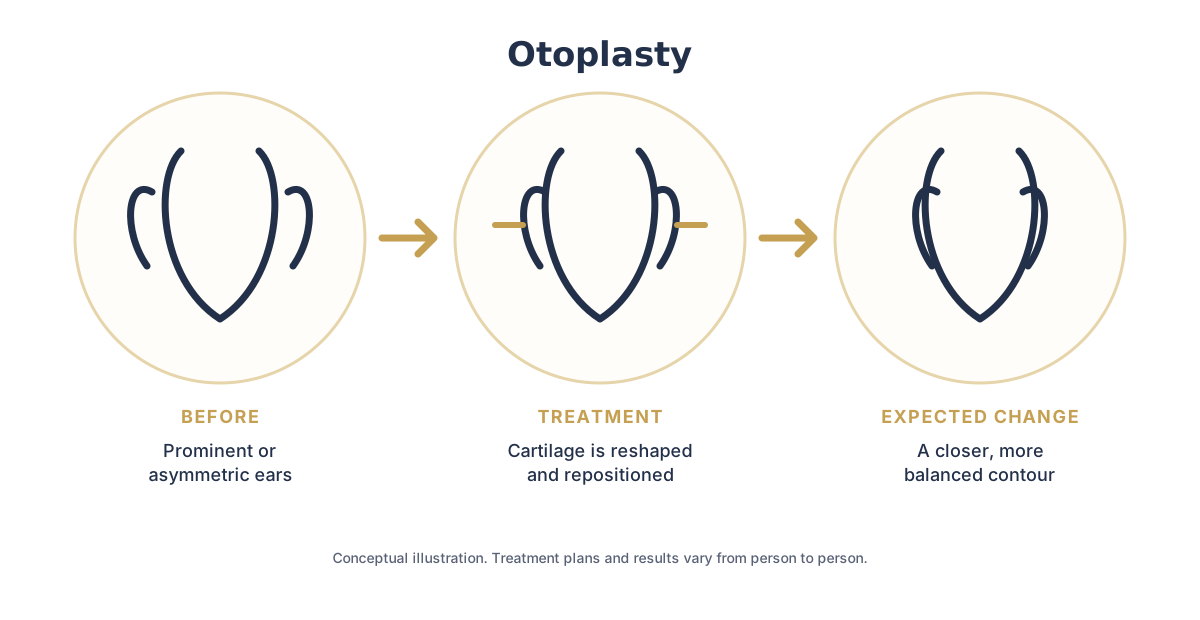
Otoplasty is a surgical procedure to alter the position, shape, size or proportion of the ears. It is most commonly performed to correct prominent ears, sometimes referred to as protruding or bat ears, where the ears sit too far from the head or lack the natural fold of cartilage that holds them close to the skull.
The procedure works by reshaping the ear cartilage through incisions placed behind the ear, in the natural crease between the ear and the head. No scars are visible from the front. Depending on the anatomy, the surgeon may fold and secure the cartilage, remove a small amount of skin, or a combination of both, to achieve a more naturally proportioned position.
Otoplasty can also address asymmetry between the two ears, correct ear deformities resulting from congenital differences or injury, and improve the overall proportional balance between the ears and the rest of the face. In some cases, only one ear requires treatment.
Is this right for you?
- Your ears protrude noticeably from your head
- You have asymmetry between your two ears
- Ear shape or position affects your confidence or hairstyle choices
- You are seeking treatment for a child aged 7 or over
- You want a discreet result with no visible scarring
Recovery & Aftercare
What to Expect
First Week
A protective head dressing is worn for the first week following surgery. Mild discomfort is expected and is well managed with standard pain relief. Sleeping on your back is recommended to avoid pressure on the ears. Most patients are comfortable within a few days.
Weeks 2–4
The dressing is removed at approximately one week and replaced with a lighter protective band, which is worn at night for a further three to four weeks to protect the ears during sleep. Swelling and bruising settle progressively, and most patients return to normal activities, including work and school, within two weeks.
Long-Term
Results are visible immediately once the dressing is removed and continue to improve as residual swelling resolves over the following weeks. Results are permanent. Strenuous physical activity and contact sports should be avoided for one month.
For UK Patients
Planning Otoplasty in Lisbon
Otoplasty is one of the more straightforward procedures to plan around travel. No hospital stay is required, and the procedure is performed under local anaesthesia with sedation. Most patients are comfortable to travel home within five to seven days of surgery, once the initial dressing has been reviewed and changed.
Flying is generally possible from around ten to fourteen days post-procedure. A lightweight protective head band, which can be worn discreetly under a hat or loose clothing, is continued at night for approximately four weeks after surgery. This does not affect normal daily activities or travel.
For patients travelling with children, the same approach applies. Children typically recover quickly and adapt well. The team will provide clear guidance for parents on wound care, activity restrictions, and what to watch for during recovery.
Otoplasty
Are You a Suitable Candidate?
You are aged 7 or over, the age at which ear development is considered complete and surgery can be safely performed
Your ears protrude significantly from your head, causing self-consciousness or practical difficulty
You have asymmetry between your ears that you would like to address
You are in good general health with no active ear infections or skin conditions in the area to be treated
You have realistic expectations about the outcome, otoplasty produces a more natural position, not a perfect geometric result
For children, the decision to proceed should involve the child as well as the parents. Surgery is most appropriate when the child themselves is motivated, not solely the parent. For adults, any long-standing concern that has affected confidence or comfort is a valid reason to explore treatment. Suitability is assessed at consultation.
Your Journey
Consultation Process for UK Patients
Initial Consultation
Your first consultation can be conducted via video call or in person in Lisbon. We will discuss your concerns, assess ear anatomy, and advise on the most appropriate technique and expected outcome. For children, both the child and the parents are involved in the discussion.
Pre-operative Assessment
Pre-operative requirements are straightforward for this procedure. Your surgeon will provide clear instructions on preparation, including guidance on medications, fasting, and what to expect on the day of surgery.
Procedure in Lisbon
Otoplasty is performed at our clinic in Lisbon under local anaesthesia with sedation. The procedure takes one to one and a half hours. No hospital stay is required. You are discharged on the same day with a protective head dressing in place.
Recovery and Return
We recommend remaining in Lisbon for five to seven days for a dressing review and post-operative check. Flying home is generally appropriate from ten to fourteen days post-procedure. A protective night band is then worn at home for a further three to four weeks.
Follow-up in Oxford
All follow-up from the two-week mark onwards is managed by our NMC-registered Advanced Nurse Practitioners in Oxford, ensuring continued care without further travel to Portugal.
Important Information
Risks and Considerations
Otoplasty is a well-tolerated procedure with a straightforward recovery. As with all surgery, risks exist and will be discussed at consultation.
- Swelling and bruising: expected and resolves over one to two weeks
- Temporary altered sensation around the ear
- Infection: uncommon; managed with antibiotics if it occurs
- Haematoma: rare; may require drainage
- Asymmetry: minor differences between the two ears may be present; perfect symmetry is not achievable
- Scarring: placed behind the ear, not visible from the front; hypertrophic or keloid scarring is rare but possible
- Partial relapse: ears may shift slightly over time as cartilage memory can persist; rare with experienced technique
FAQs
Frequently Asked Questions
From what age can otoplasty be performed?
Otoplasty can be performed from the age of 7, when ear cartilage development is typically complete. It is suitable for both children and adults. For younger children or those who are anxious, general anaesthesia may be more appropriate than local with sedation, this is discussed at consultation.
Where are the scars placed?
Incisions are placed in the natural crease behind the ear, between the ear and the side of the head. They are completely hidden from the front and camouflaged by the ear itself. Scars heal well in this location and are typically imperceptible within a few months.
Can otoplasty be performed on just one ear?
Yes. If only one ear is prominent or asymmetrical, surgery can be performed on that ear alone. In some cases, minor adjustments to the other ear may also be recommended to improve overall symmetry, this is assessed at consultation.
Are the results permanent?
Yes. The structural changes made to the ear cartilage are lasting. Natural ageing continues over time, but the repositioning achieved by otoplasty is not reversed by this. In rare cases of partial relapse, where the ear shifts slightly, a minor revision may be considered.
How soon will results be visible?
Results are visible immediately once the head dressing is removed at around one week. The ears will still have some swelling at this point, which settles over the following weeks. The final result is typically well established within two to three months.
Ready to Take the Next Step?
Book a consultation with our specialist plastic surgery team in Lisbon, with pre and post-operative support available in Oxford.